
Wednesday, 3 July 2013

Friday, 19 April 2013
Tuesday, 16 April 2013
Wednesday, 27 March 2013
Evaluation
Our film uses forms and conventions of real media products by
firstly using different types of camera shots that allow the audience to feel
more involved in the film. We used crab shot at the start of the opening to
build tension on the features of the main character. Tension enables the
audience to interpret specific details in the film that aren’t given away
easily. We decided we didn’t want our film to be solely a thriller, so we put
some humour in the middle. Even though the audience may not find it funny, the
idea is for them to acknowledge it and understand our reasons for using
differing aspects; that subvert the traditions of a thriller.
Our film represents particular social groups so the audience
doesn’t feel like the film is dedicated to specific types of people. The
concept of using a female as the victim was on the basis of the typical
characters in thrillers, yet we contrasted this by adding a male even though
our group was solely girls. The fact our opening was to cater to the thriller
genre, it was hard to understand if all types of the audience would like this
certain genre of film. So we thought an all-girl group would shed some light on
our interpretation of a thriller without the stigma of thrillers being for the
male sex.
When discussing the type of media institution that might
distribute our film, we thought Colombia Pictures as it caters more to 15+
films. The other organisations such as Disney or Paramount Pictures have often
promoted child films, so if they were to produce a thriller film there are
problems with how seriously the film will be taken. We also saw our film being
promoted through newspapers, trailers to other films, TV and websites like
YouTube or Facebook. This allows everyone to see the promotions, as the film is
seen as viral.
The target audience for our film is based on a large variety.
We understood the image attached to thrillers involved male adults; however we
argued the point that it generally depends on the likes and dislikes of the individuals
in the audience. Therefore we decided not to group the target audience as a
whole, but try to cater to their separate tastes.
Attracting the audience was a difficult task that our group
should have considered more of, but in all we went with what we thought was the
best. The title of the opening, REVENGE, allows the audience to imagine
different meanings for what the film involves. It interests them into actually
coming to see the film, and if they don’t like it then that’s their own
opinions; but at least they know what the film is about and understand the
outcome.
In the process of constructing this film, our group learnt a
lot about the technologies we had to use in filming. The video recorder was
quite straight forward to use and we had no major difficulties with using it.
However, the tripod concerned us in the movements and tracking of the
characters. We found the angles problematic as we visualised the scenes to look
a certain way, but the development of these scenes were much harder than we
anticipated. As a group we learnt to use the equipment with patience but also
admiration as we began to recognise different ways of using them.
Looking back at our preliminary task, we definitely learnt
many relevant aspects to making a film. Firstly, without learning the thriller
conventions and theories of Todorov and Propp, we wouldn’t have had any
awareness of what we needed to do or even how to do it. The camera shots were
easy because they enabled us to see them in ways which were easily understood
on our terms. However, our group didn’t realise the many features of the film
we had to acknowledge and discuss, these included: actors, location, sound,
roles and responsibilities and representation. As we grasped the concepts and
there impacts on the film, we began to realise that we need them in order to
create a real film; that differs completely from our continuity task.
Tuesday, 26 February 2013
Research - BBFC: Movie Age Classification
What does a 15 involve?

- strong violence
- frequent strong language.
- portrays sexual activity.
- strong verbal references to sex.
- sexual nudity.
- brief scenes of sexual violence or verbal references to sexual violence.
- discriminatory language or behaviour.
- drug taking.
Title and Credits
Title of Film: Revenge
Credits: In our thriller opening we will begin with the opening, and when the last shot is filmed, the names of the 3 Characters, the camera man and director will be credited before the movie title comes up saying in big white letters with a black background, REVENGE.


Credits: In our thriller opening we will begin with the opening, and when the last shot is filmed, the names of the 3 Characters, the camera man and director will be credited before the movie title comes up saying in big white letters with a black background, REVENGE.


Friday, 15 February 2013
Planning - Representation
The representation of a character wasn't a major issue with our group as there is no certain hero or villian. Amal plays a victim without really conforming to any typical tendencies such as being white or dressed in pink. However her gender and characteristics of being a 'high school bitch' would show understanding to why she has become a victim in the first place. Seen as the killer is anonymous within the three minute opening, he/she doesn't represent any type of group. This was decided as a way to keep all clues covered or any suspisions uncertain, thus allowing us and the audience to explore different stories behind each character and their representations in the thriller. Nick represents the small humour that exists in every thriller, that little part that shifts your feeling of suspense to laughter; completely contradicting the whole film.
Friday, 8 February 2013
Planning - Call Sheet Example
Filming Day One:
Date: 12/02/13
Time: 1:30
Location: Sixth Form toilets
Actors: Amal
Props: Make-up bag
Costumes: None
Equipment:Clapper-board, Camera
Crew, Roles and Responsiblities: Shukri/Cameraman, Tiffany/Director, Rhea/Director, Amal/Actress.
Shot list: Crab shot, Zoom shot
Date: 12/02/13
Time: 1:30
Location: Sixth Form toilets
Actors: Amal
Props: Make-up bag
Costumes: None
Equipment:Clapper-board, Camera
Crew, Roles and Responsiblities: Shukri/Cameraman, Tiffany/Director, Rhea/Director, Amal/Actress.
Shot list: Crab shot, Zoom shot
Friday, 1 February 2013


Planning - Purpose and Distribution
The purpose of the opening thriller is to advertise the film to the audience, with more people acknowledging the film the rate of views will increase. The opening scene will advertise the plot, the characters and the actors that play them. Advertising a product is mainly distributed through:
Television - constant adverts, premiere viewings, etc.
Internet - social networking, youtube, news websites, etc.
Often, films use a well known or up-and-coming song to promote their film and to boost the views on the internet. A good example of this is the remake of Fitzgerald's Great Gatsby. Due to the remake being modernised, the promotional song No Church in the Wild by rap artist Jay Z has attracted a wider variety of audience.
Television is a more traditional method of distribution when it comes to the media, this is due to large amounts of the population doing nothing more than watching T.V therefore the media targets certain types of the audience to cater their promotions to.
The internet is for the more modern population, the ones who find it easier to access more complicated aspects of the internet in order to get what they want. These people are able to see the trailer, find out the plot, while figuring out if this is their 'type' of film.
Television - constant adverts, premiere viewings, etc.
Internet - social networking, youtube, news websites, etc.
Often, films use a well known or up-and-coming song to promote their film and to boost the views on the internet. A good example of this is the remake of Fitzgerald's Great Gatsby. Due to the remake being modernised, the promotional song No Church in the Wild by rap artist Jay Z has attracted a wider variety of audience.
Television is a more traditional method of distribution when it comes to the media, this is due to large amounts of the population doing nothing more than watching T.V therefore the media targets certain types of the audience to cater their promotions to.
The internet is for the more modern population, the ones who find it easier to access more complicated aspects of the internet in order to get what they want. These people are able to see the trailer, find out the plot, while figuring out if this is their 'type' of film.
Planning - Target Audience
Even though our opening thriller consists of the typical teenage girl becoming victim to a killer, doesn't necessarily mean that the film is aimed at teenagers only. We thought that the idea of producing a thriller would not only attract the horror crazy teens but also the adults who enjoy the investigation and chase rather than the killing. By attracting all age groups, we succeed in catering to a major percentage of the general target audience. The debate about thriller's being more of a man's 'thing' can been argued that it depends on the tastes of the individual, therefore the gender stigma attached to a woman's 'supposed' taste is no more than a stereotype. Our opening thriller will not cater to a certain type of gender and by supporting this we introduced Nick to constrast the female roles of killer and victim.
The audience should be able to feel a sense of ecapism, a need to get away from their own lives and live someone elses; even if it is only for an hour or so. A thriller provides the audience with a life completely different from their own;villians and heros, battles between Good and Evil. The audience get to feel like they are involved in the film and acknowledge the real and surreal aspects of the film as things they love.
The audience should be able to feel a sense of ecapism, a need to get away from their own lives and live someone elses; even if it is only for an hour or so. A thriller provides the audience with a life completely different from their own;villians and heros, battles between Good and Evil. The audience get to feel like they are involved in the film and acknowledge the real and surreal aspects of the film as things they love.
Planning - Roles and Responsibilities
Tiffany: Directing and Editing
Shukri: Filming and Editing
Rhea: Acting, Filming and Editing
Amal: Acting and Costume Design
Nick: Acting
Shukri: Filming and Editing
Rhea: Acting, Filming and Editing
Amal: Acting and Costume Design
Nick: Acting
Planning - Sounds
The sounds in our thriller opening will be limited, silence builds up suspense and otherwise doesn't give away much from the film but also doesn't over do it with too much speech. Another option was to use subtle but tense background music to show the audience where the scary parts may be, this then doesn't make the dialogue the only sounds we put into the opening and therefore gives a wide variety to get our point across.
Thursday, 31 January 2013
Planning - Location
Our thriller opening will be set in the school toilets, which therefore creates a tense atmosphere and brings a sense of danger and fear to a somewhat normal but familiar place. The idea of doing our thriller opening in the toilet allows us to hide other characters in the many cubicles, while only having to base our plot in one location. Our group had the intention of making the film black and white, to make it more original and otherwise different to other openings. Our influence came from the Kill Bill: Volume One opening, it may not be a thriller but Tarantino cleverly has contrasted an old fashioned filming method with a modern plot.
Planning - Actors
Throughout our thriller there are only three actors. Amal plays the first of many victims, thus leading the plot to question why she was killed. We make sure she is seen as nothing more than a simple girl, so the questions of her death lingers and are hard to solve until half way through. Nick acts a randomer, the idea is for him to be a passer-by having no knowledge of anything, resulting in no interest being given from the audience. This could leave space for Nick maybe to return during the film. Rhea plays the killer, however isn't actually seen in the whole three minutes. This was decided as we thought this would create more suspense and therefore only allow us to reveal the killer at the inevitable end.
Wednesday, 30 January 2013
Ideas for Filming - Common features of a thriller
A thriller generally uses suspense, tension and excitement as the main elements in the film. Thrillers are seen as stimulators for the audience's moods, giving them a high level of anticipation, expectation, uncertainty, surprise, anxiety and/or terror. Thriller films tend to be filled with adrenaline, whether its action-packed or involving a serial-killer. Plot twists and cliff hangers are used constantly as a result of a rousing, fast-paced plot. A thriller conforms to a villain-driven plot, where he or she presents obstacles that the protagonist must overcome.
Common subgenres are psychological thrillers, crime thrillers and mystery thriller. The spy genre, which deals with fictional espionage is another common subgenre used to create an idea for the audience of alternative lifestyle of a spy. A successful example of a thriller is Alfred Hitchcock's PSYCHO.
The aim of a thriller is to keep the audience on edge throughout the film, also no matter what subgenre the film falls into the idea is to emphasize the danger that the protagonist must face. The fight and chase are common methods in all of the thriller subgenres, although each subgenre has its own unique characteristics and methods. The thriller is supposed to provide a sudden rush of emotions, excitement, sense of suspense and exhileration that drives the narrative and therefore keeps the audience interested for the duration of the film.
CHARACTERS:
-The protagonist faces death, either their own or someone else's.
-The antagonist must initially be more clever and/or stronger than the progonist.
-Either by accident or their own curiosity, random characters are dragged into a dangerous conflict.
CHARACTERS include criminals, stalkers, assassins, innocent victims, psychotic individuals, serial-killers, police and convicts, characters with dark pasts, etc.
STORY AND SETTING:
-Thriller plots involve characters which come into conflict with eachother or with outside forces - the threat is either known from the start or unseen up until the sudden end. Thrillers often portray the world and society as dark and therefore produce a plot of similar darkness-'pathetic fallacy'.
Common subgenres are psychological thrillers, crime thrillers and mystery thriller. The spy genre, which deals with fictional espionage is another common subgenre used to create an idea for the audience of alternative lifestyle of a spy. A successful example of a thriller is Alfred Hitchcock's PSYCHO.
The aim of a thriller is to keep the audience on edge throughout the film, also no matter what subgenre the film falls into the idea is to emphasize the danger that the protagonist must face. The fight and chase are common methods in all of the thriller subgenres, although each subgenre has its own unique characteristics and methods. The thriller is supposed to provide a sudden rush of emotions, excitement, sense of suspense and exhileration that drives the narrative and therefore keeps the audience interested for the duration of the film.
CHARACTERS:
-The protagonist faces death, either their own or someone else's.
-The antagonist must initially be more clever and/or stronger than the progonist.
-Either by accident or their own curiosity, random characters are dragged into a dangerous conflict.
CHARACTERS include criminals, stalkers, assassins, innocent victims, psychotic individuals, serial-killers, police and convicts, characters with dark pasts, etc.
STORY AND SETTING:
-Thriller plots involve characters which come into conflict with eachother or with outside forces - the threat is either known from the start or unseen up until the sudden end. Thrillers often portray the world and society as dark and therefore produce a plot of similar darkness-'pathetic fallacy'.
Tuesday, 29 January 2013
Planning - StoryBoard

Step by Step Plot:
1.Crab shot - AMAL walking to toilets.
2.Zoom in on hand reaching for door handle.
3.Crab shot - AMAL walking into toilet.
4.Tilt shot - AMAL doing make-up in mirror
5.Zoom shot/Mid shot-hears a noise, dismisses it, hears it again.
6.Point of view shot - moves towards toilets.
7.Point of view shot - steps slowly towards toilet door, reaches
to knock.
8.Person rushes out, pushes AMAL aside and staggers out.
9.Mid shot - AMAL goes to turn around but hears slam! Figure
in background moves.
10.Crane shot - AMAL walking towards last toilet.
11.Long shot - AMAL reaching for door.
12.Point of view shot – KILLER grabs AMAL’s neck.
13.Long shot - AMAL dragged into toilet.
14.END! credits.
Planning - Group Discussion
My group decided that we should base our opening three
minute thriller on the SCREAM bathroom scene, which conforms to the typical
conventions involved the thriller genre. The idea was to use our characters to
portray the intense moment of introducing the killer and its victim, in order
to develop our plot further, mostly to give the audience a insight into what our 'film' is
about. The plot remains similar to the scene from SCREAM but with enough of our
ideas to make it more original to us.
Research - Todorov and Propp
Todorov’s narrative theory: Todorov suggests
that stories being with a status quo where any opposing forces are in balance,
some event will disarray this balance setting of a series of commonly bad
events and then the problem is solved and order is restored. This is said to be
structure in five stages:
•A stage of equilibrium at the outset .
•A disruption of the
equilibrium by some action.•A recognition that there has been a disruption.
•An attempt to repair the disruption.
•A reinstatement of the equilibrium.
This theory is common in all of the James Bond films and traditions fairytale films such as Snow White or Aladdin. The film always contains a protagonist and an antagonist and most often a villain to test their heroic abilities.
Propp’s character theory: Propp indicates that there are seven main character types produced in most of the media. These include:
•The villain, who struggles against the hero.
•The donor, who prepares the hero or gives him so magical instrument.
•The helper, who accompanies the hero on their quests.
•The princess, who marries the hero and is often the damsel in distress.
•Her father, usually dies before or during the film.
•The dispatcher, who sends the hero off to his quest.
•The hero or victim hero, reacts to the donor and weds the princess.
When applying Todorov and Propp to our ideas we found that our opening thriller is not really similar to their beliefs of the typical thriller convention. Our opening dose not have a clear representation of equilibrium, it is also too short for the audience to feel a sense of 'Good vs Evil' foreshadowing the idea of restored equilibrium. In addition, Propp's theory also has limited similarities. The supposed 'villian' could be argued to be the killer, but this would imply that there is a 'hero' and to be honest it is too early in the thriller to know. Seen as our project was aimed at only producing a three minute opening, our thriller not only has no 'set group' it can be put into but also conforms to none of the major theories concluded about films in general.
Research - Thriller Conventions
Thriller
Conventions come in many different ways, there used to make the thriller effect
work and create a sense of suspense, tension and uncertainty. Common sub-genres
are psychological thrillers, crime thrillers and mystery thrillers. Also the
spy genre with deals with fictional espionage is also popular.
The
target audience whom are most likely to watch thrillers are stereotyped to be
men, apparently men are more inclined to watch thrillers because they enjoy the
action and crime.
This film conforms to the typical conventions by basing the plot around crime and deception. The twists and tricks involved in the film are used to make the plot more interesting, a thriller is never straight-forward and it’s always making the audience gasp with shock or sigh with relief.
On the other hand, this film subverts the typical conventions by making the protagonist and the antagonist the same person, which at first is confusing but as the plot plays out, every single detail begins to make sense.
Research - Thriller Conventions:Salt
Salt is a movie based around one CIA agent who is suspected to be a Russian spy, the title implies that Salt is the main character and uses the character second name only as a way of stating uncertainty; if she is a spy, is Salt her real name?
Similar to many films, the title is an obvious link to the film. Its shows a double meaning, which allows us to create our own analysis on what the film could be about without watching it. The subtitle at the bottom says “Who is Salt” – this adds to the idea of not knowing whether she the predictable heroine or villain.
The cover has a more black and white contrast, which could show the battle between ‘Good and Evil’. This is conforms the thriller genre, as everyone expects the fight between both sides because it’s predictable. The central face shows no expression, she nor happy or sad, which could imply she gives nothing away and has an unpredictable character.
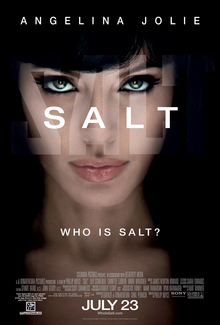
Angelina Jolie plays the main character Evelyn Salt, who goes on the run to try and clear her name after being accused of being a Russian sleeper agent. She starts off as the typical protagonist CIA agent, but then the plot becomes extremely witty and unpredictable by changing the protagonist into the antagonist. By protesting her innocence at the start, the viewers are fooled into thinking there has been a mix up and that she really is the heroine of the story. Unfortunately, there is no happy ending to the story as the viewers find out that she is in fact a spy.
The story is set in New York and Washington DC, but avoided the typical “post-card views” because Noyce wanted the setting to be more realistic, i.e. Masses of buildings and dense crowds of people, instead of the idyllic perception we have of the two cities
•Forty seconds into the film there is a point of view shot, showing Salt looking at her captors. This shows the audience her surroundings and the people who have captured her, but also it gives a sense of being ‘in her shoes’.
•There is also countless shot reverse shots, showing the conversation between Salt and captor, Salt and the Russian defector, etc. This shot is able to track whoever is talking at the time and also the facial expressions of the characters.
•Half way through the film, a lot of tracking shots were used to show certain objects in a room without using more than one take. Tracking shots were also used to make reference to the action packed film; all the fighting scenes were either shot reverse shot or tracking shot.
Throughout the film there is dramatic music that plays at every tense moment, at some points silence would be much preferred as it would make the whole tense feeling stronger. Obviously the cities the film is set in are noisy and over populated, but in most scenes the sound is coming from the surroundings i.e. Transport, People; instead of the annoying, yet ironic dramatic backing music.
Similar to many films, the title is an obvious link to the film. Its shows a double meaning, which allows us to create our own analysis on what the film could be about without watching it. The subtitle at the bottom says “Who is Salt” – this adds to the idea of not knowing whether she the predictable heroine or villain.
The cover has a more black and white contrast, which could show the battle between ‘Good and Evil’. This is conforms the thriller genre, as everyone expects the fight between both sides because it’s predictable. The central face shows no expression, she nor happy or sad, which could imply she gives nothing away and has an unpredictable character.
Angelina Jolie plays the main character Evelyn Salt, who goes on the run to try and clear her name after being accused of being a Russian sleeper agent. She starts off as the typical protagonist CIA agent, but then the plot becomes extremely witty and unpredictable by changing the protagonist into the antagonist. By protesting her innocence at the start, the viewers are fooled into thinking there has been a mix up and that she really is the heroine of the story. Unfortunately, there is no happy ending to the story as the viewers find out that she is in fact a spy.
The story is set in New York and Washington DC, but avoided the typical “post-card views” because Noyce wanted the setting to be more realistic, i.e. Masses of buildings and dense crowds of people, instead of the idyllic perception we have of the two cities
•Forty seconds into the film there is a point of view shot, showing Salt looking at her captors. This shows the audience her surroundings and the people who have captured her, but also it gives a sense of being ‘in her shoes’.
•There is also countless shot reverse shots, showing the conversation between Salt and captor, Salt and the Russian defector, etc. This shot is able to track whoever is talking at the time and also the facial expressions of the characters.
•Half way through the film, a lot of tracking shots were used to show certain objects in a room without using more than one take. Tracking shots were also used to make reference to the action packed film; all the fighting scenes were either shot reverse shot or tracking shot.
Throughout the film there is dramatic music that plays at every tense moment, at some points silence would be much preferred as it would make the whole tense feeling stronger. Obviously the cities the film is set in are noisy and over populated, but in most scenes the sound is coming from the surroundings i.e. Transport, People; instead of the annoying, yet ironic dramatic backing music.
Subscribe to:
Posts (Atom)